Wednesday, August 10, 2016

Narmada Bachao Andolan - 30 years of India's greatest people's movement for environmental justice


To mark 30 years of Narmada Bachao Andolan (NBA)'s resistance to the hydro dam projects in the Narmada valley, I dug up this image of the Narmada Jan Vikas Sangharsh Yatra of December 1990, that first appeared on the front page of the now defunct 'The Independent', that was launched and edited (for a very short time) by Vinod Mehta.
I was assigned to cover the week-long march and joined thousands of anti-dam protestors led by Baba Amte and Medha Patkar on their march from Barwani in Madhya Pradesh to Ferkuva on the Madhya Pradesh–Gujarat border.

This is where I first met activists like Medha Patkar, Shripad Dharmadhikary, Rohit Prajapati, Himanshu Thakkar, Arundhati Dhuru, Simantini Dhuru, Alok Agarwal, Ashish Kothari, to name only a few of so many more in the following years, who have shaped and influenced my understanding of the greatest people's movement for environmental justice in modern India.

25 years later, the people’s demands for suitable rehabilitation have not been met and neither has the promise of delivery of Narmada waters to the villages of Kutch, but worst of all no lessons have been learnt and the people have come together again to save their homes, villages and forests. "Narmada ki ghati me ab ladai jaari hai" - The slogan I heard first time on this march is ringing again in the valley since last week.

In August 1993 I posted this report for Frontline Magazine- Manibeli's woes .


Monday, July 25, 2016

Glacial lake threatens Sikkim’s heritage village


“Mosquitos and tourists!” Chokdup Lachenpa shouts at no one in particular as he takes a long sip of Tongba (hot beer) from his bamboo mug.  As if on cue, the children chorus, “The first is because of climate change and the second is the cause of climate change,” causing much mirth and laughter among the customers.

We are sitting at Chokdup’s daughter’s tiny teashop-cum-bar in Lachen, a small village perched 2,750 metres above the mean sea level (MSL) on the right bank of the Lachen Chu river in North Sikkim. Outside, in the foggy twilight, across the Himalayas, we can see the headlights of a cavalcade of vans and jeeps that will soon bring hundreds of tourists to Lachen for a night’s halt.

A view of the Lachen Valley

Situated on a grassy mountain slope, surrounded by snow-capped peaks and forests of rhododendrons and conifers, Lachen is so beautiful it has been declared a “heritage village” by the Sikkim government. And that is its problem. The tag is accompanied by “eco-tourism homestays” pushed strongly by bureaucrats.

It is the last stop for tourists going to Gurudongmar Lake, 5,430 metres above sea level. Buddhists and Sikhs consider the lake sacred. Now, tourists from Maharashtra and Gujarat seem to be competing with the peripatetic Bengalis to make Lachen the number one tourist attraction in North Sikkim.

Feeling the heat

What most of the tourists won’t know is that Lachen valley is facing a massive climate crisis. Behind those welcoming smiles, the Lachenpas – the local residents, an indigenous tribe of the Bhutia community – are a worried lot. Reduced snowfall, unseasonal rains and the forest fires of last summer have made them all very anxious.

To make matters worse and potentially dangerous, Lachen is in the path of the streams flowing down from the growing Lake Shako Cho. The lake at the snout of the glacier by the same name is growing because the glacier is melting faster. It is identified to be at high risk of causing a glacial lake outburst flood, a type of flood that occurs when the gravel holding in such a lake collapses.

A dried up snow stream in Lachen

According to an independent risk assessment modelling by a group of scientists led by R. Worni, “The natural gravel embankment holding the Shako Cho Lake inside could burst at any time, releasing a tidal wave of water. Thangu, a village of about 100 homes immediately below the lake, would be obliterated. The ensuing flood could also demolish houses here in Lachen, 11 miles farther downstream, especially those near to the unstable bluffs of the lake-fed river that runs just east of the village.”

Climate change and glaciers

Climate change is already decimating mountain glaciers almost everywhere on earth at the rate of 3% every year. In India, Himalayan glaciers have lost about 10% of their volume in the past four decades. The Jemu Glacier, not very far from Lachen, has retreated by around 20 metres per year during 1975-90, scientist Jagadish Bahadur wrote in his book titled Himalayan Snow and Glaciers – Associated Environmental Problems, Progress and Prospects.

Even Gurudongmar Lake, the local attraction, has shrunk considerably, according to the residents, raising a question about the sustainability of the tourism industry. The rich biodiversity is also at risk.

“Lachen was the first village to ban plastic water bottles in India. We have always practised organic farming, we have no industry that emits carbon dioxide, we have no emissions, we own very little, nothing compared to the people from the cities,” Hishey Lachenpa states as she serves me another glass of hot tea.

Hishey Lachenpa in her tea shop

The rest of the teashop customers have left to placate the tourists emerging, after slamming car doors, the babble of Marathi, Gujarati and Bengali demanding tea, hot bath water, soda, room heaters and food.

Hishey is 18 years old and studies in class 12 in a public school near Gangtok. She is back home during the summer vacation to help her mother, who has converted a tiny 12 x 12 feet toehold into her home, grocery store, teashop and bar. Hishey’s father is a monk and rarely visits them. She sleeps here with her mother, sister and an adopted younger brother.

“This year we had very little snowfall. Normally we have snowfall from December to February. This year we had snow only in December and then a little in January. But the rains seem to have come early. It will surely affect the potato farmers in Thangu.” Hishey, who has studied climate change at school, says with some authority. Numerous studies have shown that climate warming has forced plants and animals to higher altitudes.

A flash of lightning heralds the long threatened storm. Two men walk into the teashop with the news that a landslide has blocked the road to Gurudongmar lake and the Indian Army can do nothing about it until the next day. So there is no need to wake up and leave at 3 the next morning. They buy two nips of rum, borrow two glasses and disappear quickly.

Traditional houses in Lachen

Gatuk Lachenpa’s house is the oldest in town, a simple two-storeyed stone, earth and lime structure that withstood the September 18, 2011 earthquake. But almost 70% of such old houses in Lachen have now been torn down to make way for gaudily painted, hurriedly built, brick and cement tower blocks, which look most fragile and unsafe, but will help maximise the benefits of tourism.

“Traditionally, Lachenpas used to cultivate barley, maize and buck wheat for their staple and potatoes, turnips, radishes, cauliflowers for their vegetables. But due to erratic weather and fear of water scarcity in the future, most of them are increasingly abandoning their farms to profit from the booming tourism business,” says Gatuk, a farmer who has just built a 50-room hotel, right next to his ancestral home in the middle of the village.

Minimising negative impacts

“Peak tourist seasons are March through May and September through November.  Seventy percent of tourists passing through Lachen are Indians. They typically stay 1–2 nights in Lachen before heading off to Gurudongmar Lake. It is good business. We have to make the most of it till it lasts. While maximising the benefits of tourism, we have to minimize its negative impacts.”  Gatuk says.

Angden Lama Peak seen from Lachen

Measures like banning plastic drinking water bottles and segregated garbage management and replanting of trees are seen as steps towards minimising the negative impacts of tourism. But Lachenpas do not know how to cope with climate change impacts and least of all about what to do if the lake overhead bursts its banks.

Sikkim’s chief minister Pawan Chamling had once famously said, “Sikkim is a mini-theatre which in a way displays how climate change triggered by non-natural forces at the global level could bring disastrous natural calamities.”

Lachen clearly is the main stage where all the catastrophic scenarios predicted by the Intergovernmental Panel on Climate Change (IPCC) are being played out every day.

“The biggest worry is water scarcity. We used to get about 10 feet of snow but last few years we have only received 2 feet. The barren patches on the Angden Lama peak where our water comes from is a constant reminder of how climate change will change everything for us in the near future.” says Palzar Lachenpa, the current Pipon of Lachen, the traditionally elected head of the local government, the Dzumsa.

“We have only just recovered from the devastation caused by the 6.9 magnitude earthquake of September 2011. All the houses have been rebuilt. Many have added extra rooms to accommodate more tourists. We will never be able to recover from another disaster. We know we are sitting right under its nose, but what can we do?” Gatuk says worriedly about Shako Cho Lake.

Climate calamity

Unseasonal rainfall, unusually stormy weather, landslides, receding glaciers, short winters, accelerated snowmelt, longer summers, fears of water scarcity, failed crops, mosquitoes, crows, tourism pressures and the clear and present of a lake that can burst its banks – Lachen is in grip of a climate calamity but this finds no mention in the Sikkim’s State Action Plan on Climate Change.

“We are doing more than our fair share to reduce carbon emissions but we need more information on adaptation to climate change, we have very little understanding of what is happening. Everything is unpredictable now — rain, snow, summer, winter, everything. We need precise weather information, we need early warnings systems and we need better predictions. More information, any information, to help me and the Dzumsa to better prepare our people for what is to come,” says the Pipon.


First publised on thethirdpole.net . 


Thursday, May 19, 2016

Sonam Wangchuk's Ice Stupas Are Firing Up Interest From Ladakh To The Swiss Alps


"The possibilities are endless." Sonam Wangchuk could be talking about any of the many ideas he has thrown at me in the last hour, but in this case he was referring to the "ice stupa", a conical two-storey-tall artificial glacier that was drip-releasing frozen water in the middle of a very hot and dry May, irrigating 5000 poplar and willow trees on the outskirts of Phayang Monastery in the mountain desert of Ladakh.

The applications of ice stupas range from irrigating dry and arid mountain deserts to mitigating dangers posed by glacial lake outburst floods (GLOFS). Most of all, Sonam is excited about reviving the rural economy of Ladakh by promoting ice stupas as a winter attraction for tourists.

The Swiss want to expand the project to build more ice stupas in 2017, mainly to counter the phenomenon of fast-melting glaciers...
This is an idea that has already been lapped up by the tourism authorities of Switzerland. Sonam Wangchuk has been invited by the president of Pontresina, a municipality in the Engadine valley near the winter sports resort town of St. Moritz, to build ice stupas to add to their bouquet of winter tourism attractions. After this prototype is built and tested, the Swiss want to expand the project to build more ice stupas in 2017, mainly to counter the phenomenon of fast-melting glaciers in the upper reaches of the Swiss mountains.

"In exchange for the ice stupa technology, the Swiss will share their expertise and experience in sustainable tourism development with the people of Phayang, to revive the dying economy of the village," says Wangchuk.

Read the full story on Huffington Post India

Letting go a precious resource


Union Minister for Water Resources Uma Bharti claims that her Ministry is already promoting rainwater harvesting and artificial recharge measures in the country. A Master Plan has been drawn and circulated to all state governments for harnessing surplus monsoon runoff to augment ground water resources.

Unfortunately, going by the actual financial allocations and institutional directives, rainwater harvesting is clearly not high on the minister’s agenda either. It is a state’s problem after all, is the constant refrain heard from the central corridors.

Here we are dealing with a full blown disaster and our only hope is to somehow survive next two months, most likely hotter than this April, and most certainly the hottest years in hundred years, after which we may have a good monsoon, as per Indian Met Department’s predictions. A monsoon that most likely will be wasted again because we forgot to fix our ancient rainwater harvesting bodies, the tanks, the ponds, the lakes, the backwaters, the rivers and the bunds.

Apathy, India’s biggest environmental threat; corruption, India’s biggest development roadblock; and greed of corporate stakeholders are at the core of the failure of implementation of rainwater harvesting policies in most cities across India.

The way forward requires a paradigm shift in water governance and the first step to achieve that is to identify, strengthen and provide legal validity to local institutions and empowerment of local communities, for ensuring equitable and sustainable use of water within ecological confines.

Both persuasive and legislative measures to involve local communities and stake-holders in the creation and maintenance of existing rain water harvesting bodies is a must and for that if criminalizing and penalizing non-conformance is the only way, then so be it.

Read the full article on Governance Today.

Saturday, April 9, 2016

No deal in Paris ?


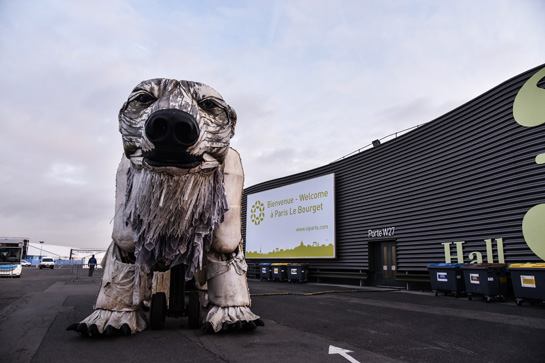
On the cold morning of December 12, 2015, Aurora, a giant animatronic polar bear, stood forlorn and forgotten outside the temporary convention centre set up in the Le Bourget Airport, the venue of the Paris Climate Summit. Inside, it was the last day of the 21st session of the Conference of Parties (COP21) of United Nations Framework Convention on Climate Change (UNFCCC).

As expected, the conference had run into extra time of one entire day. After 21 years of haggling, another 21 hours didn't seem to bother anyone, and red-eyed delegates who had stayed up all night helping their governments negotiate tricky text options were seen huddled around the coffee booths. All of them aware of the burden of the failed Copenhagen Climate Summit that must not be repeated. Climate change had already unleashed runaway disasters in the four years since that last attempt to bring the world together to take action. All hopes of an outcome, good or bad, were now upon Laurent Fabius, the President of COP 21, who was shepherding the world’s governments to finalise a treaty that will have grave impact on the future of the planet as we know it.

For the first time in 21 years of knowing that they had to deal with the phenomenon of global warming, nearly 200 nations were on the verge of “recognising that climate change represents an urgent and potentially irreversible threat to human societies and the planet and thus requires the widest possible cooperation by all countries, and their participation in an effective and appropriate international response, with a view to accelerating the reduction of global greenhouse gas emissions and also recognising that deep reductions in global emissions will be required in order to achieve the ultimate objective of the Convention and emphasising the need for urgency in addressing climate change .”

Finally when Laurent Fabius struck the specially designed green gavel, the most memorable achievement of the Paris agreement was that “it aims to strengthen the global response to the threat of climate change by pursuing efforts to limit the temperature increase to 1.5 °C above pre-industrial levels.”

- Read the whole comment on Sanctuary Asia

Tuesday, December 22, 2015

A beginner's guide to what transpired at the Paris climate summit


What did you bloody greenies do ? What is this Paris climate deal?
After 21 years of haggling and delays, governments of the world collectively agreed to take action domestically and internationally to tackle climate change by cutting their carbon emissions/ The “Paris package” to which the legally binding instrument – the “Paris agreement” – is annexed aims to contain the increase in the global average temperature to “well below 2°C above pre-industrial levels and to pursue efforts to limit the temperature increase to 1.5°C above pre-industrial levels” – a more ambitious goal than had been expected. This new climate deal will come into force in 2020.

Meaning how, exactly?
Mainly by boosting clean energy investments while conserving and enhancing forests and other ecosystems. Boosting clean energy investments means more finance for research and deployment of renewable energy and energy efficiency, with the hope that burning of fossil fuels will be phased out by end of the century. However, nowhere in the text are the words fossil fuels, coal or oil used. Conserving and enhancing forests should mean more “predictable, sustainable, large-scale pay-for-performance finance”. Right now, the cash box is more or less empty, but hopes are tied to private financing.

Is renewable energy really ready for all this?
I caught a plane from Kochi airport, the world’s first fully solar-powered airport. I think it is.

What about forests?
The agreement includes the necessary technical and scientific rules to provide a blueprint to countries looking to protect natural forests and their biodiversity, as well as the rights of indigenous peoples and local communities, with the inclusion of Reducing Emissions from Deforestation and Forest Degradation as a standalone article.

Most importantly, it includes a system to report on how those safeguards are addressed and respected. This sets a precedent for protecting rights in all climate actions, and for the protection of natural forests. It’s important to note that there has been plenty of research demonstrating that market-based initiatives, which REDD+ focuses on, are unlikely to be the solution in and of themselves.


Sweet invitation for private financing for afforestation projects.


So it's all about money?
Yes.


Climate change is happening faster than system change: the impossible demand of social activists.


So, is the deal good or bad?
Let's just agree with activist George Monbiot: "By comparison to what it could have been, it’s a miracle. By comparison to what it should have been, it’s a disaster."

No, seriously, is that good or bad?
For those who remember the debacle at the Copenhagen summit, where talks failed at the last minute, the Paris agreement is "good" in so much as that countries have finally acknowledged that they have a problem and have agreed to take collective action, but mostly “bad” because to meet these ambitious goals, the world will need to spend more than $16tn over the next 15 years.

However, the Paris Agreement only commits to "mobilising" $100 billion per year by 2020 to cover not just emission cuts but also adaptation. This is far short of the support required, and there is no firm commitment to increase this figure, merely an aspiration to review it by 2025. And since it is about money, basically no one knows where the money is coming from and until then, countries are allowed to continue emitting against self-designated targets, aka Intended Nationally Determined Contributions.

So why is everyone celebrating ?
Not everyone is, but more on that later. First, you must understand that the Paris Agreement would not have been possible if the countries had not resorted to the strategy of win some, lose some and compromise on others. No country or group can claim an outright victory on any of the contentious issues, and at the same time each of them had something to celebrate.

The ones I saw cheering the most in the plenary were the staff of the French presidency and United Nations. For them to lead and ensure the successful conclusion of a multilateral process with world leaders in attendance, at a time when France technically is at “state of war”, is a huge shot in the arm.

The Americans were dancing on the floor of course. President Barack Obama finally has a legacy to justify his Nobel Peace Prize, while his team led by Secretary of State John Kerry can boast of diabolical brinksmanship - they escaped any binding commitment by replacing “shall” with ‘should” in the text.

The Chinese were brimming because they see huge market opportunities ahead, while the Indians were seen backslapping because the agreement reflects differentiation, acknowledging that the world is not homogeneous either. The decision will be implemented to reflect “equity and the principle of common but differentiated responsibilities and respective capabilities, in the light of different national circumstances.”

And your friends, the green ones?
Have you been listening or not? This is it, their moment of reckoning. Imagine world governments parroting your lines, “coal kills – renewable energy is the future, save forests, change lifestyles”. It's 20 years later and probably too late, but what the hell. Now my bloody greeny friends, as you like to call them, have a moral high ground as climate guardians and raison d'etre to continue to harangue their respective governments to deliver on the promises they made in Paris.

So who is not celebrating?
The ones who are at the bottom of this soon-to-be unleashed financial trickle, for whom it is not about money at all but about daily survival, representatives of the people’s movements, of grassroots NGOs and indigenous people, the workers unions and the rights activists. Before the talks began, they had agreed on a set of criteria that the Paris deal would need to meet to be effective and fair. This "People’s Test" is based on climate science and the needs of communities affected by climate change and other injustices across the globe.

To meet the People’s Test, the Paris deal would need to do the following four things:

* Catalyse immediate, urgent and drastic emission reductions

* Provide adequate support for transformation

* Deliver justice for impacted people;

* Focus on genuine, effective action rather than false solutions

Clearly the Paris summit, in its bid for consensus, has failed to pass the test, according to them.


Paris is beautiful, despite its lingering sadness.


So another world is not possible?
No. Climate change is happening faster than system change. And there is no provision in the treaty for compensation and liabilities for loss and damage that has already happened due to climate change.

Forget it. How was Paris?
Paris is beautiful, like its people. The weather was mostly grey and the mood sombre. Despite the lingering sadness following the terror attacks in the city in November, the people were most tolerant and polite – beautiful people who understand the meaning of "tolerance" and practice it. They were nice to us suits too.

So did you go party?
No, I followed our prime minister’s advice to the world and did not change my lifestyle. Barring one evening, I ate Indian food every night. I highly recommend Saravana Bhavan and Sangeeta near Gare du Nord terminus for vegetarian food.

Shailendra Yashwant (@shaibaba) travelled to the Paris summit in a borrowed suit and on a ticket paid for by Climate Action Network South Asia, a coalition of 141 NGOs that he advises on communication and advocacy strategies.

First published on Scroll.in

Thursday, December 17, 2015

Tourists From The Dark Side


August 15, 2015, Periyar Tiger Reserve, Kerala: The elephant turned his head around as soon as the mobile phone rang. Incredulously, the young man ignored the loud caller tune and continued taking pictures of the glaring pachyderm. His wife also turned her attention and phone towards the elephant to nonchalantly shoot a quick succession of pictures using her camera flash. The driver started the jeep and could be heard cursing the couple as he reversed and swiftly drove away.

Ajayan, the upset jeep driver, told me later that he had informed the young honeymooning couple very clearly before the trip that “they are not allowed to use camera flash, that phones must be on silent, they should not wear bright colours and if they did not follow rules I could not guarantee their safety. But the two of them were ‘hopeless’ and broke every rule. I had to leave in a hurry not because the elephant had shown any signs of discomfort or displeasure, but because I know even elephants have limits to their patience.”

On January 20, 2015, not very far from here, allegedly provoked by a camera flash, an elephant lost his patience and killed Bhupendra (52) and Jagriti Ravel (50) in the Gavi forest of the Periyar Tiger Reserve. The forest guide accompanying them was forced to abandon the couple after they failed to heed his warning to stop taking pictures and run. This is not an isolated incident but typical of the rising animal-tourist conflict unfolding in our parks. (See box: ‘The Last Selfie’)

-Continue reading the covers story in Sanctuary Asia magazine.

Wednesday, January 28, 2015

Run Gibbon Run!


With dilution of environmental laws on anvil, a wildlife board at the beck and call of profiteering corporations and a government hell bent on allowing polluting projects around forest areas, I despair wondering about the future of this Hoolock Gibbon and other endangered species in the last remaining forests of India. 

Monday, August 12, 2013

Brahmaputra and the temples of doom


The boat lurched dangerously. A sudden change in the water current slapped us around for a few minutes, and the river began rising rapidly, unexpectedly. There were no clouds in the sky, no signs of an impending storm, no radio reports of rains upcountry. In fact the weather forecast promised a clear and sunny day in the entire region when we began our journey upriver in the morning.

“These days the Brahmaputra needs no rain, rhyme or reason to swell suddenly like this,” says Jadav Payeng, aka Mulai, a Mishing cowherd now famous as the Forestman of Assam. “As if the deadly floods caused by the monsoon downpour between June and September every year are not enough, since the last few years we have seen floods in the  Brahmaputra, with or without rains -- in summer, monsoon, winter. It is like someone is controlling the water flow but is not very good at it. I am certain the dam-building activity upstream is responsible, either dams in Arunachal Pradesh or Tibet, with Indian or Chinese  control. Whoever is responsible is blind. They don't know what they are doing to the thousands-of-years-old civilisation and still undiscovered biodiversity wealth downstream.”

He exchanges a quick, decisive glance with the other oarsmen and changes the course of the boat to drift back to the northern bank where we will wait on higher land till this bout of unseasonal flood passes. Jadav Payeng has lived on the river all his life; he criss-crosses it every day to go to his home island Aruna Sapori, where he single-handedly planted a 1,360-acre forest over 30 years, now named the Mulai Kathoni after him. He has observed the cycle of floods and erosion of the tempestuous Brahmaputra from close quarters. His forest, like so many others along the river, has been sustained by these seasonal, life-giving floods of the river and its many tributaries.

Continue reading on Infochangeindia

Wednesday, July 31, 2013

Troubled Dibru Saikhowa


Three of India’s eastern-most rivers, Siang, Dibang and Lohit, meet the mighty Brahmaputra river at a unique tri-junction near the borders of upper Assam and Arunachal Pradesh. Located at this confluence, on an island about 12 km. from the tea town of Tinsukia, is the Dibru-Saikhowa National Park and Biosphere Reserve. Spread over 765 sq. km., of which 340 sq. km. form the core of this magical land, this park is a complex of wetlands, grasslands, littoral swamps and semi-evergreen forests, including the largest salix swamp forest in Northeast India.
Walking from Kundaghat to the Balijan forest check post inside the Dibru-Saikhowa National Park on a wet day in April 2013, I spotted Citrine Wagtail, Sultan Tit, Common Stonechat, Indian Roller, Yellow-bellied Prinia, a silhouette of a hornbill that swooped overhead and finally a Jerdon’s Bushchat, a black and white sparrow-sized bird that had not been seen in these parts for over two years. Winter, when the many rivulets and rivers crisscrossing the park have dried up, is the only time when the trek is possible. When the rains pour down, and even for several months after that, access is by boat alone.
In the distance I heard Hoolock gibbons singing their strange songs high up in the canopy of silk cotton, Indian lilac and red cedar trees. I also saw macaques scampering along the branches of a shisham tree and followed a wild hare through my field glasses as it made its way across a clearing in the grassland. Toward the edge of the grassland, a herd of elephants had rested the night before and I could see tell-tale evidence of their fruit-feast from the Outenga (elephant-apple) tree. Around me was a virtual wonderland. I saw willow trees… the ones that make such great cricket bats and hockey sticks. Also what locals call kappofool, the gorgeous pink orchid, in full bloom that heralded the Assamese spring festival of Bihu. 
On the boat back to the mainland, Gangetic river dolphins surfaced near us as they fed from waters that also supported Spot-billed Ducks, herons and an amazing diversity of other waterfowl. In the distance, on the banks of one of the chaporis, I spotted a herd of wild buffaloes retreating into their forest.
Dibru-Saikhowa in spring teems with life of all descriptions, like a virtual showcase of the incredible biodiversity that Northeast India harbours. In my book, Dibru-Saikhowa is up there with Khongchengdzonga and Kaziranga, but as I soon discovered, there is trouble brewing in paradise.
- for full story continue  reading on Sanctuary Asia

Wednesday, January 2, 2013

The strange Obsession of Jadav Payeng

Jadav Payeng in his forest

In 1979, Jadav Payeng, a.k.a. Mulai, a cowherd, started planting trees on a desolate, barren island formed by the ever-shifting sands of the Brahmaputra river, near his island home of Aruna sapori in the Jorhat district of Assam.

Payeng of the Mising tribe of Northeast India, previously known as the Miris, the second largest ethnic group in Assam after the Bodos, was hired as a labourer for an afforestation project undertaken on 200 ha. of land on Aruna sapori by the Social Forestry Division of Golaghat district in 1979. The five-year project was abandoned in three years and while the rest of the workers packed up and disappeared into government files, Payeng, who had nowhere else to go, continued to plant more trees, while nurturing the existing vegetation, on his own.

For almost 30 years, off everyone’s radar, without support or subsidies, without fear or favour, without Forest Department or foreign hand, Payeng, almost obsessively, continued to expand the forest and the fruit of his labour is now being celebrated around the world.

Read the whole story online Sanctuary Asia

Saturday, November 24, 2012

Majuli - Lost Island

Neo-Vaishanite monks practicing drums at a Satra


On October 28 this year, from a plane between Guwahati and Jorhat, I witnessed  firsthand how  the Brahmaputra river,  reddish-brown and silt-laden, braided with hundreds of sandbars and islands, snakes its way through a  web of channels , creating a terrain of constantly mutating boundaries.

The 2,900-km-long river originates in Tibet as the Tsangpo, flows through Arunachal Pradesh as the Siang, and becomes the mighty Brahmaputra in the Assamese plains before draining into Bangladesh as the Jumna. It is prone to catastrophic flooding every year when the Himalayan snowmelt combines with wanton monsoon downpours. By September this year the river had swollen and flooded thrice, leaving a trail of destruction and displacement three times worse than last year.

Amongst the worst-affected was the riverine island of Majuli, considered the cradle of the Ahom civilisation, fountainhead of neo-Vaishnavism and my final destination for this leg of my journey across the Northeast.

Continue reading on Infochangeindia.org

Wednesday, October 10, 2012

The wettest desert on earth


Cherrapunji aka Sohra receives about 11,777 mm (463.7 in) of annual rainfall between June and October but all those millions of cubic tonnes of water simply drain down the mountains into the Bay of Bengal via the plains of Bangladesh less than 250 miles below, leaving Sohra parched and thirsty every year. When the monsoons disappear Sohra is dry and there is no water to drink by November. By December the locals are at the mercy of the tanker-gods as is evident from the annual news picture of women and children clamouring for drinking water at tankers or trudging uphill with their pots to suck up some water from the depths of the mountains.

Read more on Infochangeindia..

Sunday, September 9, 2012

Kaziranga's quandary


Until recently poaching was considered the biggest threat to Kaziranga's denizens, especially rhinos, to feed the great Chinese appetite for rhino-horn, which is considered an aphrodisiac. In 1992, 48 rhinos fell to the guns of poachers. Since that ghastly year there has been a constant decline in poaching incidents thanks to the valiant efforts of the forest department but poaching has not been brought totally under control. Today, the real danger to Kaziranga's animal populations is habitat destruction caused by what scientists call 'increasing anthropogenic pressures' or destructive human activity, which is slowly eroding the park's boundaries.

Read more on Infochangeindia

Saturday, September 1, 2012

Requiem for an Ape – Sumatra’s vanishing orangutans.


Bohrok, Gunung Leuser National Park : For almost an hour, the Orangutan sat forlornly on the feeding platform. His expression improved slightly when he saw Mas Ota walking up the hill carrying a bucket of milk and a bag of bananas. He pounded on the wooden floor with both his arms and hooted his appreciation when Mas Ota threw a bananaat him. A few minutes later, more orang-utans emerged from different directions of the rain-soaked forest. A mother with an infant on her belly slid in graciously from the canopy above. A solitary young male swung in silently and dropped lightly on the feeding platform. A brooding older Orang utan hung on to a branch far away choosing not to join the party but watch from a distance at the Bohorok Orangutan rehabilitation center in Indonesia’s famous Gunung Leuser National Park, west of Medan in Sumatra.
Sumatran Orangutans (Pongo abelii) are listed as critically endangered species of great apes by the World Conservation Union, the United Nations and other agencies. There are only about 7000 of them left in the rapidly disappearing rainforests on the island of Sumatra. Bornean orangutan (Pongo pygmaeus) have fared slightly better and their numbers in the wild are pegged at about
35000 according to conservative estimates.

The Bohrok center is now in disrepair and the rehabilitation program established in 1970s, primarily to help young animals rescued from pet bazaars and burning forests learn how to adapt to life in the jungle, temporarily discontinued.

According to Mas Ota, a volunteer at the center for 15 years, many of the orangutans keep coming back to the center’s feeding platform out of sheer habit during their daily 1-2 km leisurely jaunt through the forests. A local forest conservation group is now running the center and is able to provide for the upkeep of the center from visitors fees.

According to many Indonesian conservationists putting orangutans back in the forest was not as simple as it sounded, nor as successful as might have been hoped. But the fact that once rescued, confiscated or found, the orangutans needed human help to adapt back to their natural surroundings cannot be faulted.

Apparently Bohrok’s goal was not simply to save a few orangutans from a life of domesticity, but to use the orangutans as an appealing symbol for the need to conserve the habitat that is home to Indonesia’s wildlife.

The sheer scale of biodiversity makes Indonesia’s rainforests one of the most important ecosystems on the planet. Rivaling Brazil in terms of biodiversity, 31.1 % of all species are endemic to Indonesian archipelago, consisting of 38000 species of plants, 1531 species of birds, 35 species of primates, 515 species of mammals including the Sumatran Tiger, Rhinoceros and Elephant, all of which are on critically endangered list.

The numbers of orangutans have been declining for years as human beings cut down the trees of the rain forest to grow rice to feed their families and make palm oil and rubber tree plantations. Some of the palm oil is used for products in the west like chocolate, ice-cream, toothpaste and cosmetics and more recently as source of biodiesel, but a large quantity of it is imported by India and China to adulterate cooking oil.

Orangutans are also killed to protect the crops and plantations and to acquire infants to sell as illegal pets. The trade of illegal orangutans sold as pets is profitable by Indonesian standards. An infant orangutan can fetch up to five hundred dollars in Jakarta, and thirty thousand dollars in the United States. Tourists buy their skulls as souvenirs.

Over two thirds of the Orangutan habitat has already been destroyed and the remaining habitat even, within the sprawling national park, is under terrific pressure from logging, mining and forest fires as well as fragmentation by roads.

Thousands of Orangutans don’t reach adulthood due to this relentless human disruption. The rapid conversion for tropical forest and peat land swamps into palm oil plantations in response to international demand in the last decade, according to some UN scientists, could lead to irreparable damage to orangutan habitat by 2012.

When I shifted the attention of my telephoto lens to a pack of leaf monkeys that had decided to join the party, I sensed a presence towards my left and noticed a sub-adult male orangutan clutching onto a cup gazing at me with great curiosity.

As I looked up from the viewfinder he made a sign that I immediately understood. He wanted me to take his pictures. I smiled back and he made a sign as if to say hurry-hurry. I was delighted and more than ready to indulge him. I had heard stories about their intelligence and communication capacity and here I was communicating with a handsome specimen of the species posing with a cup of milk in his hands.

Orangutan’s hands are similar to human hands with four long fingers and an opposable thumb, ditto their feet have four long toes and opposable big toe. Orangutans can grasp things with both their hands and feet and are known to use found objects as tools, for example they use leaves as umbrellas to keep the rain from wetting them and also use leaves as cups to help them drink water.

In fact, as I discovered later, two orangutans at Miwlaukee County Zoo have been playing with Ipads in their giant, gentle palms. They even have their favourite apps, often spending quite a bit of time finger painting with DrawFree, watching television shows and even playing games.

In the wild, Orangutans live a more solitary lifestyle than other great apes. Spending nearly all of their time in the trees, most of the day is spent feeding, resting and moving between nesting sites. They start the day feeding for 2-3 hours in the morning. Fruit makes up 65-90 % of orangutan’s diet. They rest during midday and when evening arrives they begin to prepare their nest on tree branches for the night in which they curl up and sleep.

Male Orangutans play almost no role in raising the young. Females are primary caregivers for the young and are also agents of socialization for them. Infant orangutans are completely dependent on their mothers for the first two years of their lives. The infant doesn’t even break physical contact with its mother for the first four months and is carried on her belly.

Watching the infant clutching on to his mother in front of me, I could see how the ‘cute-factor’ of young orangutan must have made them irresistible as pets, a fad that caught on in the 1960s when hundreds of orangutans were kept by wealthy Indonesians and Malaysians as status symbol. Most had left martyred mothers behind in Borneo or Sumatra.

But the real cost was much higher. Often both mother and infant were killed in the ‘collection’. The orangutan traders first had to separate a baby from its mother.

Nobody discovered a more efficient technique than Alfred Russell Wallace’s. “We found it to be a rather large one, very high up on a tall tree,” the great naturalist wrote. “At the second shot it fell rolling over, but almost immediately got up again and began to climb. At the third shot it fell dead. This was also a full grown female, and while preparing to carry it home, we found a young one face downwards in the bog. This little creature was only about a foot long, and had evidently been hanging to its mother when she first fell. Luckily it did not appear to have been wounded, and after we had cleaned the mud out of its mouth it began to cry out, and seemed quite strong and active.”

Obviously much of orangutan’s personality is an ape one based on millions of years of genetic inheritance. In fact, on the very day I was in Bohrok, on 26th January, 2011, an international team of researchers announced that they had successfully decoded the genetic sequence of Susie, a female Sumatran orangutan from Texas zoo, along with a few of her kin in the wild. The sequenced genomes of this great ape and her kin, our most distant living relatives in the hominid family, evolved more slowly than that of chimps and humans, the team found.

By analyzing certain variations in the DNA sequences, the researchers also concluded that the Bornean and Sumatran species diverged about 400,000 years ago. Since the split, the inhabitants of Sumatra became more genetically diverse than Borneo’s residents, despite their smaller population size.

But despite this knowledge the reality is inescapable. The species are dying. The extinction of Orangutan, especially the Sumatran orangutan in next 50 years is inevitable. The facts are plain.

I had, in my last five years, been campaigning to protect the last remaining rainforests of Indonesia and experienced first hand the devastation caused by rapidly expanding palm oil plantations. I have walked through deliberately started forest fires. I was shown but not allowed to photograph a burnt corpse of an orangutan. I had flown over the gigantic network of drainage system that was slowly wiping out peat land forests, the natural habitat of these orangutans.

Observing the orangutan mother and her infant at play I realized how much our species resemble each other. After all these primates are along with chimpanzees, bonobos and gorillas – the great apes – our closest animal relatives.

We share at least 97 % of our DNA with orangutans and the resemblance doesn’t end there. In the way they express themselves, in using tools, in solving problems, even in some of the aspects of the earliest linguistic abilities. The resemblance is complete in the way both humans and orangutans need creature comforts and can be creative in finding them.

Primatologist, Carel Van Shlack of University of Zurich discovered for example, that orangutans make what appears to be a leaf doll that they take to bed with them, just as human beings would. They also decorate their nests with a row of neatly arranged twigs.

The bucket of milk was empty, the bananas had disappeared and after a while the orangutans slowly started disappearing themselves. Mas Ota told me that the orangutans never stop in the same spot to feed for more than a couple of hours.

And anyway it was now time for them to go higher up in the canopy to start making their nests to rest for the night.

I wonder if orangutans had the ability to dream. And if they did, what did they dream about or is their sleep only filled with nightmares. Memories of burning forests, of being separated from their dead mothers, of cages and human cruelty. I wondered if they were able to dream a dream where there was an end to the relentless greed of the human species, whether they dreamed a dream of a never- ending paradise forest.